
La Tomatina Festival and the Worlds Biggest Food Fight
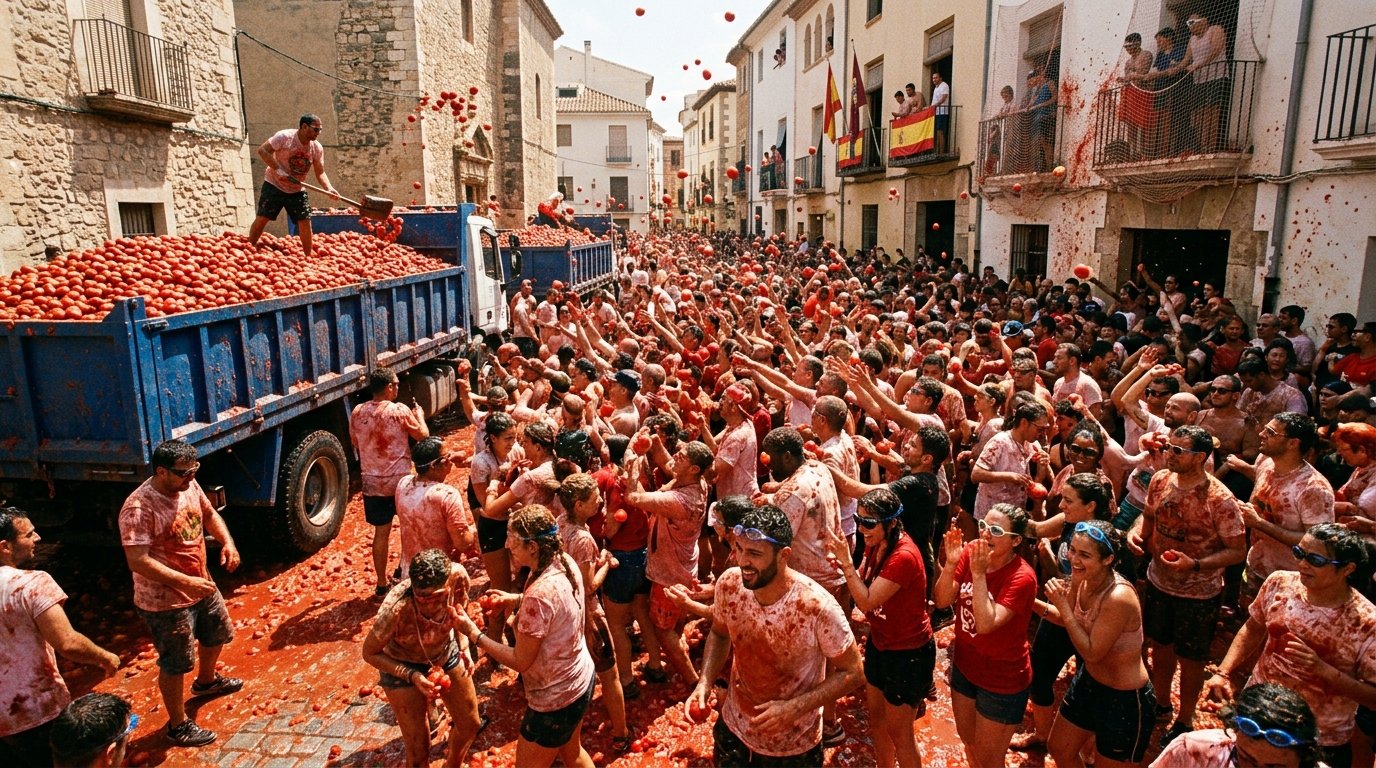
La Tomatina Festival and the Worlds Biggest Food Fight – La Tomatina Festival is one of the most unusual and entertaining celebrations in the world. Every year, thousands of people travel to the small Spanish town of Buñol to take part in an enormous tomato fight that transforms streets into a sea of red. What began as a spontaneous local event has become an internationally recognized festival, attracting visitors from different countries who want to experience its chaotic, colorful, and unforgettable atmosphere.
Held annually on the last Wednesday of August, La Tomatina combines Spanish tradition, music, celebration, and pure fun. Participants gather in the center of Buñol, prepare for the event, and wait for trucks carrying tons of ripe tomatoes. Once the signal is given, the tomatoes become ammunition for one of the world’s biggest food fights.
Beyond the spectacular images, however, La Tomatina has an interesting history and cultural significance. The festival reflects the creativity of local communities and demonstrates how an unexpected event can eventually become an important tourism attraction.
The History of La Tomatina
La Tomatina dates back to 1945 in Buñol, a town located in the Valencia region of eastern Spain. According to the most commonly told story, the tradition began during a local parade. A group of young people reportedly became involved in an argument or disturbance near the parade, and tomatoes from a nearby market stall were used during the commotion.
The following year, some participants returned to the same area and deliberately brought tomatoes with them. Although local authorities attempted to stop the activity at various points, the tradition continued to attract attention.
During the 1950s, the tomato fight was temporarily prohibited. Residents, however, continued to show their enthusiasm for the unusual celebration. Public interest eventually helped bring the event back.
By the 1980s, La Tomatina had grown significantly. Television coverage and international media attention introduced the festival to audiences far beyond Spain. Tourists began traveling to Buñol specifically to participate in the tomato fight.
Today, La Tomatina is considered one of Spain’s most distinctive festivals. Its development from a small local tradition into a major international attraction demonstrates how cultural events can evolve while maintaining their original spirit of community celebration.
When and Where Does La Tomatina Take Place?
La Tomatina takes place in Buñol, approximately 40 kilometers west of Valencia. The town itself has a population much smaller than the number of people who may attend the festival, making the event particularly remarkable.
The main celebration occurs on the last Wednesday of August. Although the tomato fight itself lasts for a relatively short period, the surrounding festivities can continue throughout the day.
The central streets of Buñol become crowded with participants wearing old clothes, swimming goggles, waterproof footwear, and other protective items. Many people choose clothing they do not mind throwing away afterward because the tomato juice can be difficult to remove completely.
The event has also developed into a broader celebration featuring music, dancing, food, and entertainment. For visitors, the experience begins long before the tomatoes are thrown.
How the World’s Biggest Food Fight Works
The main event follows a surprisingly organized process despite the apparent chaos.
Before the tomato fight begins, participants gather in the designated area. One of the traditional highlights is the attempt to climb a tall, greased pole to reach a ham placed at the top. Once the ham is successfully retrieved, the official signal for the tomato fight is given.
Large trucks then enter the streets carrying huge quantities of ripe tomatoes. The tomatoes are distributed or dumped into the crowd, and participants immediately begin throwing them at one another.
For approximately one hour, the streets become a giant tomato battlefield.
Participants throw tomatoes in every direction, cover their friends with tomato pulp, and create an atmosphere filled with laughter and excitement. Some people simply enjoy being part of the crowd, while others enthusiastically participate in the food fight.
When the final signal is given, everyone must stop throwing tomatoes. Firefighters and cleanup crews then begin the difficult task of restoring the streets.
Why Are Tomatoes Used?
The choice of tomatoes is one of the most recognizable aspects of La Tomatina. The tomatoes used for the event are generally ripe and unsuitable for normal commercial sale because of their condition.
Using tomatoes that are no longer ideal for retail consumption gives the event an additional practical dimension. Rather than being presented as premium food products, they become part of a temporary cultural celebration.
The tomatoes are soft enough to reduce the risk of serious injury when used appropriately. Participants are generally encouraged to crush tomatoes before throwing them and avoid targeting people at close range.
This is important because, despite its playful nature, La Tomatina involves thousands of people in a confined space. Following safety instructions helps ensure that the event remains enjoyable rather than dangerous.
What Happens During the Festival?
Although the tomato fight is the main attraction, La Tomatina is more than one hour of throwing tomatoes.
The festival atmosphere begins early. Visitors can explore Buñol, enjoy traditional Spanish food, listen to music, and participate in other activities associated with the celebration.
Restaurants and local businesses often become especially busy during the festival period. Streets are filled with visitors, performers, and residents, creating a lively atmosphere throughout the town.
For many tourists, the social aspect is just as important as the tomato fight itself. People from different countries can find themselves standing next to strangers and participating in the same unusual experience.
The event encourages spontaneous interaction. Language barriers often become less important when everyone is covered in tomato juice and laughing at the same situation.
Preparing for La Tomatina
Anyone planning to attend La Tomatina should prepare carefully.
Old clothing is strongly recommended because the clothes worn during the tomato fight may become heavily stained or damaged. A simple T-shirt and shorts are often more practical than expensive clothing.
Protective eyewear can also be useful. Tomato juice can irritate the eyes, especially when thousands of participants are throwing tomatoes around.
Closed footwear with a secure fit is preferable to loose sandals. The streets can become extremely slippery once they are covered with tomato pulp and juice.
Participants should also protect valuable belongings. Phones, cameras, wallets, and other electronics can easily become damaged by water and tomato juice. Waterproof cases or leaving unnecessary valuables behind can reduce the risk.
It is also important to stay hydrated. August temperatures in Spain can be high, and participants may spend hours outdoors before and after the main event.
Safety Rules Matter
La Tomatina looks completely chaotic, but safety rules are an essential part of the celebration.
Participants should avoid throwing hard or uncrushed tomatoes because they can cause injuries. People should also avoid aggressively pushing others, climbing on vehicles, or interfering with emergency personnel.
When the official ending signal sounds, participants are expected to stop immediately.
The slippery environment is another major concern. Walking carefully is important because tomato-covered streets can become difficult to navigate.
Respecting other participants also makes a major difference. The festival is intended to be playful rather than violent. Treating the tomato fight as a friendly celebration helps preserve the atmosphere that has made La Tomatina famous.
The Economic Impact of La Tomatina
La Tomatina has become an important tourism event for Buñol and the surrounding Valencia region.
Thousands of visitors create demand for hotels, restaurants, transportation, shops, and other tourism services. Local businesses can benefit from the large influx of people during the festival period.
International attention also provides promotional value for the region. Images of Buñol covered in red tomato pulp have become instantly recognizable around the world.
For a relatively small town, hosting an internationally known event provides an opportunity to showcase local culture and attract visitors who may otherwise have never considered traveling to the area.
The festival therefore demonstrates how cultural traditions can contribute to local tourism and economic activity.
La Tomatina and Social Media
Social media has played a major role in making La Tomatina even more famous.
Photographs and videos of participants covered in tomato juice are highly visual and immediately understandable. A person does not need to know Spanish or understand the complete history of the event to recognize what is happening.
Instagram, TikTok, YouTube, and other platforms have helped spread images of the festival to millions of potential travelers.
The visual nature of La Tomatina makes it particularly suitable for social media. Bright red streets, enormous crowds, colorful clothing, and smiling participants create memorable photographs.
As a result, the festival has become an attractive destination for travelers looking for unusual experiences that they can share online.
Environmental Considerations
An event involving huge quantities of tomatoes naturally raises questions about waste and environmental management.
After the tomato fight, large amounts of tomato pulp cover the streets. Cleanup crews work quickly to remove the remains and restore the town.
Organizers and local authorities have increasingly focused on managing waste, water use, transportation, and other environmental concerns associated with large-scale tourism.
The use of tomatoes that are unsuitable for normal commercial sale can also help reduce concerns about using high-quality food purely for entertainment. Nevertheless, food waste remains an issue worth considering as festivals around the world become larger.
Balancing tradition, tourism, and environmental responsibility is increasingly important for modern cultural events.
Why La Tomatina Is So Popular
There are many reasons why La Tomatina continues to attract international visitors.
First, it is genuinely unusual. There are countless festivals around the world, but few involve thousands of people throwing tomatoes at each other.
Second, participation is relatively simple. Visitors do not need specialized athletic abilities or extensive cultural knowledge. The main requirement is enthusiasm and a willingness to get completely covered in tomato pulp.
Third, the event creates a powerful sense of community. Participants from different backgrounds temporarily become part of the same enormous celebration.
Finally, La Tomatina offers an experience that is difficult to reproduce elsewhere. Watching videos can show the scale of the event, but standing in a street surrounded by thousands of people and mountains of tomatoes is an entirely different experience.
La Tomatina as a Cultural Attraction
Although tourists have transformed La Tomatina into an international spectacle, the festival remains closely connected to Buñol.
The event demonstrates how local traditions can survive and adapt over generations. What began as an unusual incident eventually became an annual celebration recognized around the world.
Its popularity also shows the appeal of participatory tourism. Instead of simply watching a cultural performance, visitors become active participants.
This type of experience has become increasingly popular among modern travelers who want more than traditional sightseeing. They want to take part in something memorable, meet people, and return home with a story to tell.
The Global Influence of Food Festivals
La Tomatina has also contributed to the growing popularity of unusual food-related festivals around the world.
Food festivals can transform ordinary ingredients into symbols of local identity and entertainment. From grape-stomping celebrations to chili festivals and food competitions, communities have found creative ways to build traditions around agriculture and cuisine.
La Tomatina stands out because the tomato is not consumed during the main event. Instead, it becomes the centerpiece of a massive public celebration.
Its success illustrates how creativity can turn an ordinary agricultural product into a globally recognized cultural symbol.
A Festival Unlike Any Other
La Tomatina Festival is more than simply the world’s biggest food fight. It is a combination of history, community, tourism, entertainment, and Spanish cultural tradition.
Every August, Buñol becomes the center of an extraordinary celebration in which thousands of people temporarily forget their everyday routines and join one giant tomato fight.
From its unexpected beginnings in the 1940s to its international popularity today, La Tomatina has developed into one of Spain’s most recognizable festivals. Its colorful streets, energetic crowds, and playful atmosphere continue to attract travelers searching for something completely different.
For anyone interested in unique cultural experiences, La Tomatina offers an unforgettable adventure. It may only last for a short time, but the memories—and the photographs—can last for years.
Ultimately, the festival’s greatest appeal is its simplicity. There are no complicated rules about winning or losing. Participants simply gather together, throw tomatoes, laugh, and enjoy the moment. That combination of spontaneity and community is what has allowed La Tomatina to become one of the world’s most famous celebrations and a remarkable example of how a small local tradition can grow into a global cultural phenomenon.
This content sponsored by https://magnaplast.id/